Until 2010, DVSA (then the DSA) published the exact routes used at every test centre in Great Britain. You could download a PDF, drive each route with your instructor, and turn up knowing precisely where you would be sent. Then they stopped — the official reasoning being that candidates were learning routes rather than learning to drive.
That reasoning was sound. But it created a persistent misunderstanding: a lot of learners now believe test routes no longer exist. They do. Every centre still runs a set of them, examiners still work from them, and they are still made of ordinary public roads that anyone is free to drive.
What a test route actually is
A route is a loop of roughly 30 to 35 minutes' driving that starts and ends at the test centre car park. It is built to cover a required mix of conditions, so route designers are looking for:
- A stretch of higher-speed road — a dual carriageway or a national-limit A road
- At least one significant roundabout, ideally multi-lane
- Residential streets with parked cars and unmarked junctions
- A hill start opportunity, where the terrain allows one
- Somewhere safe to perform a manoeuvre and, on some tests, an emergency stop
- Enough continuously signed road to support 20 minutes of independent driving
That checklist is why routes cluster so tightly around each centre, and why every centre has its own notorious feature — a particular roundabout, a filter lane that catches people out, a residential grid where nobody is certain who has priority.
Why the roads explain the pass rates
The gap between the best and worst pass rates in Great Britain is enormous — well over 30 percentage points. It is tempting to read that as some examiners being harsher, but the far simpler explanation is the road network.
A centre whose routes run through quiet market-town roads presents a fundamentally easier drive than one whose routes cross six-lane urban roundabouts in heavy traffic. Same standard, same marking sheet, very different 40 minutes. The pass rate table reads almost as a map of road density once you know that.
How to practise routes properly
The distinction that matters is between rehearsing turns and removing surprises. The first is useless — you will not know which of a dozen routes you are on, and the examiner may deviate anyway. The second is genuinely valuable.
- Drive the area, not the sequence. Get familiar with the major junctions and roundabouts near the centre so none of them is the first time.
- Go at the same time of day as your test. A junction at 10am on a Tuesday and the same junction at 4:30pm are different problems.
- Practise the awkward bits in isolation. If there is a lane-discipline roundabout everyone mentions, do it ten times, not once.
- Ask your instructor. Local instructors know their centre's routes intimately — they sit in on tests every week.
Getting the routes
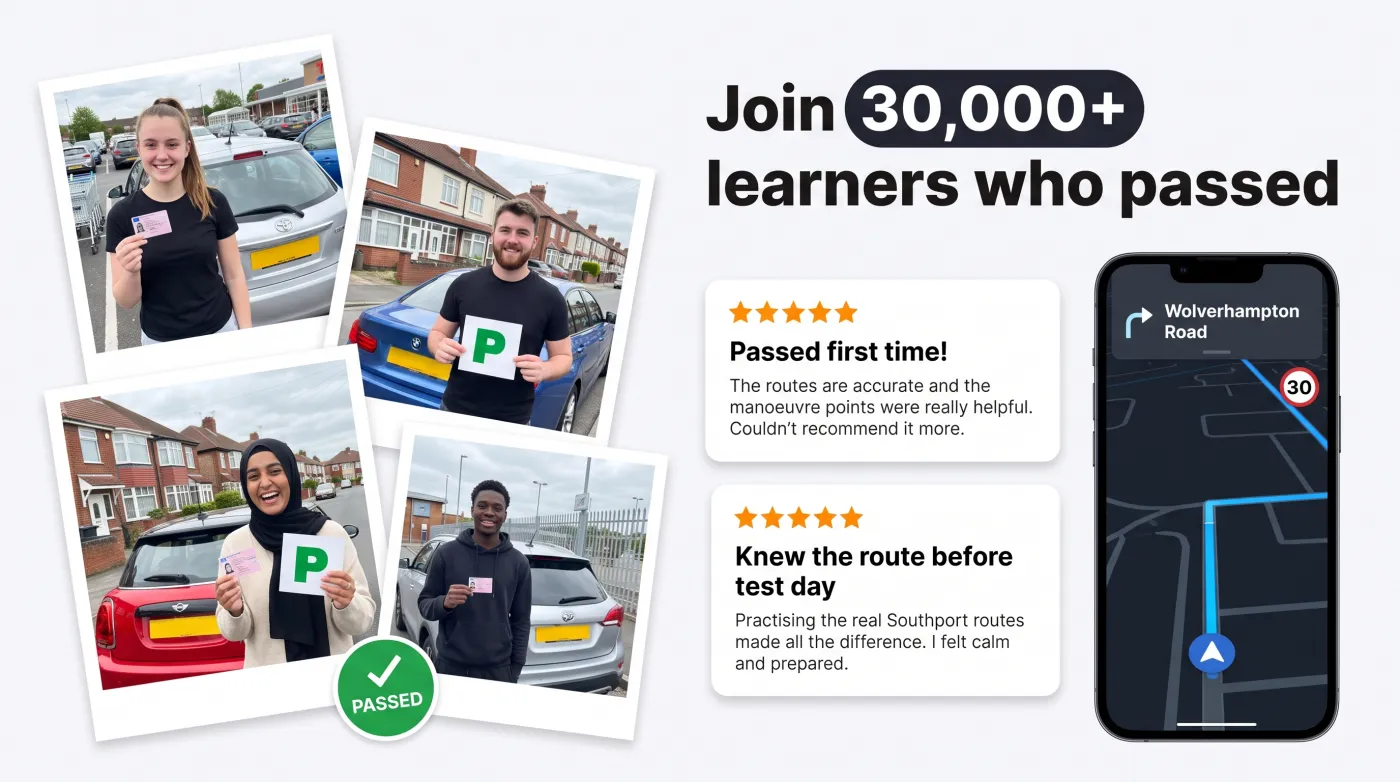
Since DVSA withdrew the official lists, route knowledge has been rebuilt from the ground up — by instructors, by learners recording their tests, and by tracing the roads examiners actually use. That is what Driving Test Routes App UK collects: mapped routes for centres across England, Scotland and Wales, with turn-by-turn guidance and speed limit alerts so you can drive them with a supervising driver rather than guessing.
Use them the right way round. The point is not to know that the third right comes after the petrol station. It is to arrive on test day having already driven every road you are about to be marked on — so the only new thing in the car is the examiner.